Should Japan Rename Its Armed Forces?

JSDF

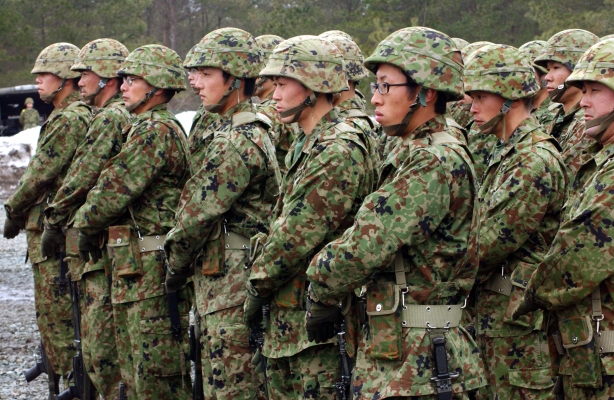
On Thursday, the Japanese cabinet approved a set of bills bolstering the role and scope of its military, as the pacifist country redefines its position in the increasingly roiled Asia-Pacific region. Since the end of the Second World War, Japan had focused solely on the defense of its home islands, going so far as to name its army the Japan Self-Defense Forces. Now, in light of recent hostile moves by North Korea, territorial disputes with both mainland China and Russia over several islands, and terrorism, Japan, at the prodding of several allied nations, looks to protect its interests by expanding its zone of control and mandate for its military. According to Prime Minister Shinzo Abe, “In the past two years, Japanese nationals have fallen victim to terrorism in Algeria, Syria and Tunisia; Japan is within range of hundreds of North Korea’s ballistic missiles and the number of (fighter jet) scrambles has risen seven-fold in a decade. This is the reality. We should not try to ignore it.”

Revisions include removing geographical constraints on logistical support for friendly forces in “situations that would significantly affect Japan’s security.”

They also say Japan can defend allies “in situations where there is a clear risk that Japan’s existence is threatened and its people’s rights…are compromised through an attack on a country which has a close relationship with Japan.”

Share This:

Erecting a New Wall

Ukranian Wall

In the early 1960s, Russia decided to construct a wall across their section of East Berlin that was designed to keep the city’s inhabitants “within” its borders. Now, fifty years later, Ukraine has decided to build a similar barrier, this time around aimed at keeping Russia out.

According to Russia Today, “Kiev authorities have approved a major new program to isolate the country from Russia by constructing an enormous barrier, equipped with anti-tank ditches and remote controlled weapons stations. They intend to spend $200 million on the grand plan.

On April 14, the Ukrainian cabinet approved a plan for technical arrangements on the Russian-Ukrainian border for 2015-2018.

The plan includes a project initially called ‘The Wall’ or ‘European bulwark’. It’s estimated to be worth 4 billion hryvnias (about $US200 million) and involves the construction of a barbed-wire fence with 17-meter high steelwork turrets. There will also be four-meter wide, two-meter deep antitank ditches, a lateral route and a drag road, remote combat modules, fortified sectors, observation posts, CCTV cameras, communication towers and alarm systems.

The plan is to complete construction within three years, yet previous intentions to erect a barrier on the Russian border floundered due to Ukraine’s lack of cash.

Initially, the idea of digging a ditch on the Russian-Ukrainian border was voiced by the former governor of Dnepropetrovsk region, Ukrainian oligarch Igor Kolomoysky. He even funded a military field engineering vehicle that created a ditch on the border with Russia.”

Barriers have been used with varying results over the course of the past hundred years. The most notable include France’s Maginot Line, Finland’s Mannerheim line, Germany’s West Wall, Israel’s West Bank Barrier, the US-Mexican Border-Enforcement Wall, and the South Korean defensive belt straddling the 38th Parallel. Considering the cost, length of its border with Russia, and much weaker military position with its neighbor to the east, its highly dubious if such a barrier could work in the 21st Century, particularly when Ukraine is already faced with mounting debt to certain international monetary agencies.

Share This:

Hobby Master Spirits Us Away this October

HM October

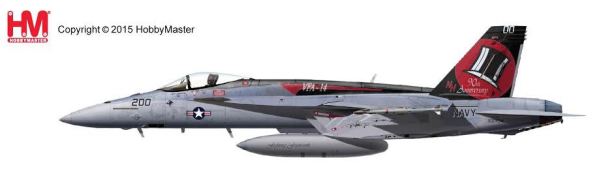
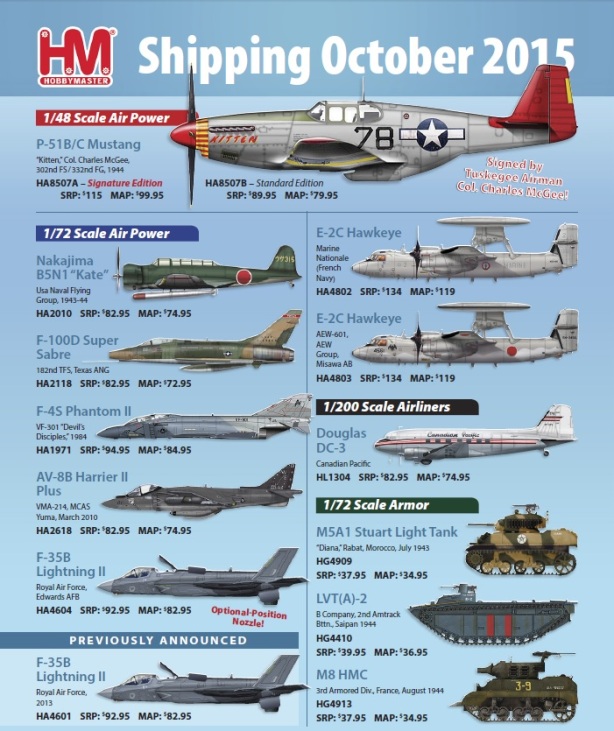
As is customary for Hobby Master, the Company has just announced their lineup for the October time frame. There’s a smattering of aircraft and vehicles that cover virtually every epoch and conflict, which is cause for celebration for a great many folks. We’re still in the process of listing all of these goodies on our site and hope to have everything up for sale by the close of business today. Enjoy!

Share This:

Can Air Force 1 Drop the Bomb in Time?

AF10112C

To further flesh out their 1:144 scale catalog, Air Force 1 today announced plans to build a replica of “Enola Gay”, the B-29 Superfortress piloted by Paul Tibbets when it dropped the first atomic bomb on Hiroshima, Japan (#AF10112). Thus far, only a line art drawing has been added to their corporate web site, even though they claim the model will be released at the end of May. Still, this comes as welcome news, since there are a great many post WWII-era bombers that could be integrated into their 1:144 scale range that collectors have been requesting for as long as we’ve been around.

Keep in mind that August 6th represents the seventieth anniversary of the dropping of the A-Bomb on Hiroshima, so it will be interesting to see if this manufacturer can get this bird up and flying in time for the event.

Share This:

Entering Star Wars Heaven

DC706069lg

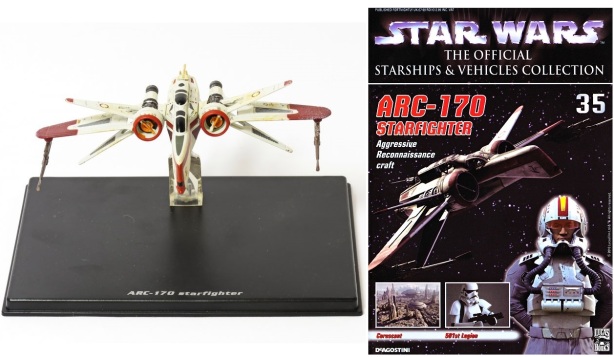
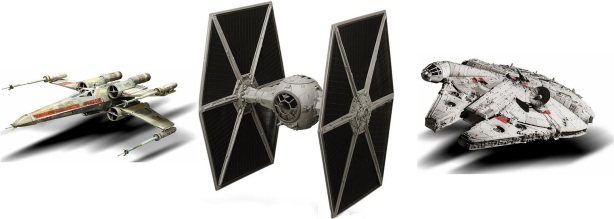
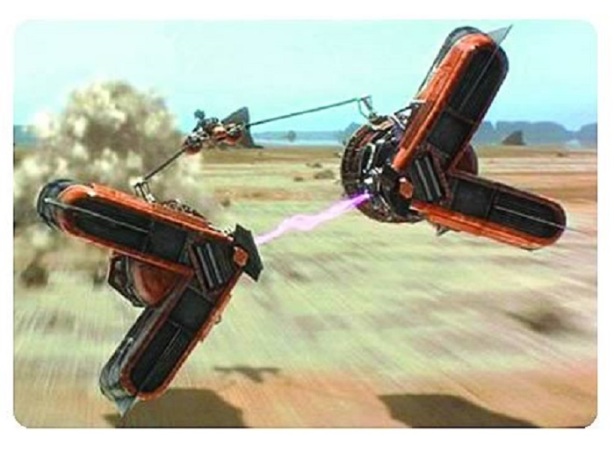
Our distributor reports that their shipment of DeAgostini Star Wars products are about to arrive at their warehouse, which means we should have them next week. Keep in mind that these are legacy-based vehicles and ships, tied to the first six movies in the series. Moreover, there is no set scale to these highly detailed products, but if you’re a Star Wars fanatic like us, then you’ll still relish collecting these movie favorites.

Share This:

Fabbri Loads ‘Em Up Again and Fires

Group2

Just when you thought it was safe to dip your toe again in the diecast waters comes news that a further eight 1:72 scale military vehicles are being released this month by Fabbri (and distributed through Eaglemoss). The latest grouping includes a Su-100 tank destroyer (#EMR0026), BTR-60 armored personnel carrier (#EMR0027), 2S9-S Nona amphibious tank (#EMR0059), GAZ 2330 infantry mobility vehicle (#EMR0060), British-built Matilda Mk. II infantry tank in Rusian livery (#EMR0061), US-built M3 Lee medium tank in Russian livery (#EMR0062), T-34/85 medium tank in winter camouflage (#EMR0063) and finally a PT-76 amphibious light tank (#EMR0069). All eight vehicles are reportedly available now at our distributor so we should have them in stock in a few days.

Share This:

The PL-01: Poland’s Answer to the T-14

PL-01

When you think of the Polish armed forces, most equate it with either their collapse at the outset of World War II or its membership in the Warsaw Pact alliance following the end of the Second World War. However, ever since the end of the Cold War in the early nineties, Poland has allied itself with the West, going so far as to become a member state of NATO in March 1999. Since that time, Poland has quietly developed its own military-industrial complex, and has even begun the arduous task of creating its own next generation main battle tank.

The PL-01 is a Polish armoured fighting vehicle created by OBRUM with support from BAE Systems. The concept vehicle project was first unveiled at the International Defence Industry Exhibition in Kielce on September 2nd, 2013. A full prototype is estimated to be completed in 2016, and should the project be finalized and approved following evaluation, mass production is scheduled to begin in 2018. Looking very much like a futuristic take on David Darke’s “Hammers Slammers,” the layout of the PL-01, nevertheless, is similar to that of modern standard main battle tanks, with the driver located at the front of the vehicle and an unmanned turret mounted in the rear. Within the hull are the commander and gunner, and the rear part of the fuselage can carry four soldiers. The vehicle chassis is based on that of the Combat Vehicle 90.

The vehicle armour has a modular ceramic-aramid shell, which is designed to provide protection compatible with NATO standard STANAG 4569 Annex A at level 5+ within the front portion of the hull and turret. Additional armour panels are mounted on the turret and hull, and are designed to provide full protection against projectiles. The hull of the vehicle provides protection against improvised explosive devices (IEDs) and landmines in accordance with appendix B parts 4a and 4b of the STANAG 4569 standard. The entire vehicle will be covered with radio wave absorbent material.

The PL-01 is to be equipped with a 940 horsepower (700 kW)+ diesel engine coupled to a torque converter, automatic gearbox and driving assistance mechanism. The suspension is based on seven wheels, with the drive shafts having active damping of torsion bars mounted on the first and last two pairs. The vehicle can reach speeds of up to 70 kilometres per hour (43 mph) on paved roads and 50 kilometres per hour (31 mph) in rough terrain with a maximum range of 500 kilometres (310 mi). It can overcome an inclination of 30 degrees, ditches and trenches to a width of 2.6 metres (8 ft 6 in), and cross water obstacles with a depth of up to 1.5 metres (4 ft 11 in) without preparation, and up to 5 metres (16 ft) deep with preparation.

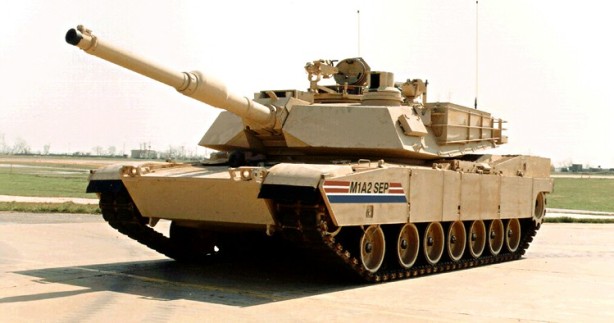
With no clear cut successor to the Abrams in sight, it would be interesting if the US DoD decided to test and procure the PL-01 for the US Army once the Abrams reaches retirement age.

Share This:

Of Black Jacks, Foxhounds and Pak FAs

MiG-31

Russia has been causing quite a stir amongst the military comunity of late, as it continues to modernize its air force with aircraft that span the gamut of combat missions. In April, The Russian Air Force added two dozen upgraded multi-role MiG-31BM fighters to its fleet and more than 100 others are expected in coming years, according to UPI.

The first 24 aircraft, which NATO calls the Foxhound, were modernized by the Rostec Corporation, which is inducting about a dozen earlier variants of the MiG-31 for upgrade each year.

Blackjack

In December, Russia finished a $103 million upgrade to its fleet of supersonic “Blackjack” bombers, bringing what was already considered the world’s fastest nuclear bomber into the 21st century with new electronic systems that could give the 33-year-old Soviet-era planes an edge in the skies over the United States B1 “Lancer” bomber.

When the Tu-160, known to American military experts as “Blackjack,” was introduced in 1981, the bomber was the crown jewel of the Soviet Union’s Air Force. Following the collapse of the communist empire a decade later, many of the Blackjack bombers were destroyed as part of nuclear disarmament deals with the West.

Su-50

Looking forward, plans are already underway to produce several variants of the Pak FA stealth fighter, in conjunction with the Indian Air Force. A family of Su-50 derivatives are planned, although no word as yet when any of these proposed systems will enter service.

Share This:

Russia’s 21st Century Under Water Navy

borei_class

While its easy for Russia to parade new ground-based weapons systems past the Kremlin in Moscow, or use the venue as a fly-over for the latest aircraft, its a far different scenario for the ships that plum the ocean’s depths. According to Defense News, “Four different kinds of submarines are under construction and more are coming. The country expects to lay down five new nuclear submarines in 2015.

The Navy is accepting Borey-class nuclear-powered ballistic missile submarines, Yasen-class nuclear attack submarines, and Kilo- and Lada-class diesel electric attack submarines. Six Kilos are being built for Vietnam and more are offered for export.

This rate of construction is beginning to look more like Cold War days rather than the lethargic shipbuilding rates prevalent since the 1990s.

Yasen

By comparison, the US only recently returned to building two nuclear attack submarines per year, and industry is gearing up to begin construction of a new class of ballistic submarines in 2021 — a three-subs-per-year construction rate not seen since the Reagan era.”

Share This:

The PAK TA – Russia’s Special Purpose Aircraft

PAK TA

As several nations celebrate V-E Day, the victory of the Allied powers over Nazi Germany some 70 years ago, Russia quietly continues to develop its’ military for the 21st Century. Meet the PAK TA, Russia’s Special Purpose Heavy-Lift Aircraft, which is designed to ferry the Armata main battle tank, and its ammunition, to anywhere in the world.

According to sources, “the new design specification from the Military-Industrial Commission in Moscow, a transport aircraft, dubbed PAK TA, will fly at supersonic speeds (up to 2,000 km/h) and will boast an impressively high payload of up to 200 tons. It will also have a range of at least 7,000 kilometers.

The PAK TA program envisages 80 new cargo aircraft to be built by 2024. This means in a decade Russia’s Central Command will be able to place a battle-ready armored army anywhere, Expert Online reports, citing a source in the military who attended the closed meeting.”

Together with other new combat systems, such as the Kurganats-25 Infantry Fighting Vehicle, Bumerang (Boomerang) 8×8 wheeled armored personnel carrier, and Borei class ballistic missile submarine, Russia seems to be spending vast quantities of its dwindling hard currency on advanced weapons systems, all designed to keep pace with recent platforms continually being shown by the West, China and other nations.

Share This: